

Compare a 500W and a 750W e-bike by first checking what each number means. If both are rated motor power under comparable definitions, 750W is the higher rating.
That still does not tell you which complete bike will be faster, climb better, or travel farther; motor layout, gearing, battery, controller, and the test route all affect the result.
Quick answer: Match the complete bike to your route and load.
- For hills: Compare the motor system and gearing.
- For speed: Compare supported assist settings.
- For range: Start with battery capacity in watt-hours (Wh).
A 750W label can be useful, but it is not an automatic upgrade for every rider.
At Heybike, we separate the rating from motor layout and ride conditions when explaining 500W versus 750W. That distinction matters in our own lineup too: comparing a mid-drive with a hub motor can help you understand two different bike designs, but it cannot isolate wattage as the cause of every performance difference.
Rated Watts and Peak Watts Are Different
Product listings may show rated or continuous power, peak power, or both. Compare like with like: rated with rated, and peak with peak.
A motor described as 500W rated with a higher peak figure is still not a 750W-rated motor. Manufacturers may use different definitions, so check the exact model page rather than assuming every label uses the same method.
What Changes Between 500W and 750W on a Real Route?
On a small screen, scroll horizontally to read the full table.
| Riding question | What the rating can tell you | What else to compare |
|---|---|---|
| Power available | A higher comparable rated figure indicates a higher published rating | Controller, battery, motor design, and exact rating definition |
| Hills | Not a guaranteed hill grade or climbing speed | Gearing, climb length, total load, and model-specific tests |
| Speed | Not the assisted-speed cutoff | Supported settings, controller, wheel size, and local rules |
| Range | Not miles per charge | Battery Wh, assist level, route, speed, and test conditions |
| Weight and price | Not determined by watts alone | Complete-bike specifications, equipment, and total cost |
Will a 750W E-Bike Be Faster?
Not automatically. Maximum assisted speed depends on the bike's supported settings and speed cutoff, as well as its controller, wheel size, and configuration.
Acceleration also depends on the complete motor system, gearing, rider input, load, and conditions. Look for comparable tests or try the exact bikes rather than translating a wattage difference into a promised speed.
Which One Is Better for Hills or Cargo?
A higher rated-power system may suit a route where you regularly want more sustained assistance, but a wattage label cannot guarantee a climbing result.
Check the climb, total rider-and-cargo weight, available gears, battery and controller, traction, and braking. Use a model-specific test under similar conditions when possible, and stay within the bicycle's total payload and any separate rack limit.
Compare motor layouts, not just watts
Motor layout changes what you should pay attention to on a test ride.
- A mid-drive works through the bicycle's drivetrain, so shift to an appropriate gear before a climb and notice whether the available gearing suits your route.
- A hub motor drives the wheel directly, so assess its response on the same climb and load.
Neither layout is a winner by definition, and torque numbers from different layouts are not a simple ranking.
Does a 500W E-Bike Have More Range?
Not necessarily. Battery energy in Wh is a better starting specification, but range also depends on speed, assist level, hills, wind, temperature, tires, and load.
Frequent high-output riding can use more energy on either system. Compare the battery configuration and the conditions behind any advertised range; “up to” is not a same-route test.
Is 500W Enough for Your Commute?
There is no single answer for every commute. Measure the whole round trip, note the longest climb, add your work bag, and decide whether you can charge at your destination.
Then compare the exact bike's gearing, battery capacity, assisted-speed settings, fit, brakes, and rated load. For a daily route, a comfortable bike that you can park, charge, and store easily may be a better fit than a higher wattage label.
When Is 750W Worth Considering?
Consider a 750W-rated bike when the specific model's motor system and supported settings match the route and level of assistance you want.
Confirm local rules and compare the whole bike, including battery, weight, brakes, tires, load limits, price, and service. If your route does not call for the extra published rating, do not pay for the number alone.
Current Heybike Examples: ALPHA and Hybrid
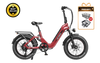
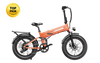
Our ALPHA pairs a 500W Mivice mid-drive with a 680Wh battery and a listed bike weight of 71.6 lb. Our Hybrid uses a 750W hub motor and lists 75 Nm torque, an 864Wh battery, and a 69 lb bike weight.
These are two different complete bikes, not a controlled wattage test: layout, gearing, tires, battery, and equipment also differ. Because torque acts through different motor layouts, torque figures from these systems should not be ranked directly. Check the product page for the current specifications and selected version.
Read range claims with their test conditions.
We list Hybrid's maximum range as up to 100 miles, tested with a 155 lb rider using PAS 1. That is a specific test condition, not a guarantee or a same-route comparison with ALPHA. Your range will depend on the bike setup, route, assist level, load, and riding conditions.
What to Check Before You Buy
- Verify rated versus peak output on both model pages.
- Compare the motor layout, gearing, controller, and supported assist settings.
- Check battery capacity in Wh and the conditions behind range claims.
- Include rider and cargo load; check separate rack limits.
- Try the bike on a similar route and confirm local road or path rules.
- Compare the complete bike's weight, fit, brakes, tires, equipment, and total cost.
For a deeper explanation of how an e-bike motor works, compare its rating with the full product specifications. You can also browse current Heybike e-bikes and verify the exact configuration before you choose.
Frequently Asked Questions
Is a 750W e-bike always faster than a 500W e-bike?
No. The assisted-speed setting and the complete system determine the result. Compare the exact model configurations.
Can a 500W e-bike climb hills?
Some can, depending on motor design, gearing, battery, hill, and total load. Look for a model-specific test on a comparable climb.
Does a 500W e-bike get more range than a 750W e-bike?
Not based on wattage alone. Compare battery Wh and similar routes, assist settings, speeds, and loads.
Choose by the ride you need the bike to repeat. Wattage is one useful specification; the right decision comes from comparing the complete system, your route, and the bike's current configuration.

Share:
How To Test An EBike Controller At Home
Ohio Ebike Laws and Regulations: What You Need to Know