



When it comes to choosing a bike, there is a lot to think about – especially if you plan to ride on rough terrain, such as gravel. From the frame size and style to tire width, all of these qualities influence your ability to ride off-road effectively.
However, this begs the question: should you choose an Ebike vs a gravel bike? Both types have their pros, cons, and use cases, which can make it hard to make an informed decision. Fortunately, that’s where we come in.
Read on to learn about the differences between Ebikes and gravel bikes. This way, you can choose the best bicycle for gravel riding.
What is an Electric Bike?
An Ebike is a bicycle powered by an electric motor. When the rider engages the pedals, the sensor detects the pedaling motion. The Ebike controller then instructs the motor to assist with rotating the pedals.
Some Ebikes have a throttle, which is operated by a twist or push mechanism on the handlebars. Using the throttle propels the Ebike forward without rotating the pedals.
Although the most convenient way to use an Ebike, the throttle also drains the battery the fastest.
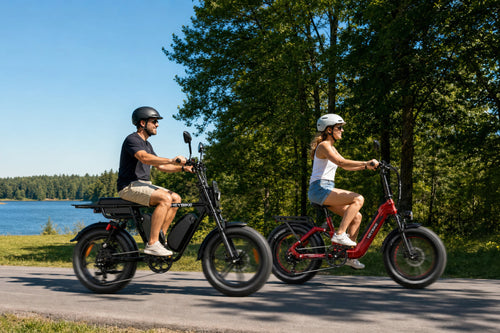
Ebikes come in many shapes and configurations. Fat-tire Ebikes are most desirable for riding on gravel roads. Their aggressive tread pattern helps evacuate debris, while their wide tire profile helps you stay balanced.

Pros of an Ebike
Riding an Ebike on gravel enables you to:
- Conserve energy and ride for longer with less sweat
- Focus on the joy of the ride and take in the scenery
- Fine-tune the pedal assist to achieve the right balance of fun and fitness
Cons of an Ebike
Despite the advantages of using an Ebike on gravel, there are downsides to consider.
- Having to factor in recharging for extended rides
- An over-reliance on the pedal assist or throttle resulting in a less intense workout
- Increased maintenance costs due to the presence of electrical components
What is a Gravel Bike?
A gravel bike is a non-electric bicycle designed for off-road use. These bikes typically have drop handlebars, large and wide tires, and a crossover-style frame.
The drop handlebars rest slightly below the seat, with handlebars that droop down in a curved manner. This encourages riders to lean downward to reach the handlebars, which can help improve your aerodynamics.
Meanwhile, the cross-over frame helps promote balance and stability, which makes it easier to ride on rough terrain.
Pros of a Gravel Bike
By riding a gravel bike on gravel roads, you will be able to:
- Maximize your fitness routine due to the lack of electric assist modes
- Navigate rough terrain with large and wide tires, with a hydraulic suspension fork for extra support
- Save on maintenance costs due to the lack of electrical components
Cons of a Gravel Bike
Despite the advantages of a gravel bike, they may not suit you for the following reasons:
- Large, wide tires are slow on flat terrain, and there is no electric assist to compensate for the increased rolling resistance.
- Drop handlebars may be uncomfortable for some people, especially elderly riders and those recovering from injuries.
- The lack of electric assist modes may limit your range, which is why touring on an electric bike is more efficient.
Ebike vs Gravel Bike Comparison
Below is a table to help you better understand the differences between Ebikes and gravel bikes.
|
|
Ebikes |
Gravel Bikes |
|
Tires |
Slim or fat tires |
Predominantly fat tires |
|
Handlebars |
Riser bar hand |
Drop bar |
|
Frame style |
Step-through or step-over |
Predominantly step-over |
|
Electric assist |
Pedal assist (optional throttle) |
No electric assist |
|
Performance |
Hub or mid-drive motors |
No motors |
|
Riding Experience |
Easier, less strenuous, faster |
More challenging, engaging, potentially slower |
Which Bike Matches Your Riding Goals?
Choosing the right type of bike for gravel riding depends on your preferences. That means evaluating your lifestyle, physical capabilities, and desired comfort levels. If you have unique fitness goals, such as the desire to lose weight, then that is another factor to consider.
Best Use Cases for an Ebike
You will benefit the most from an Ebike if you need the electric assist modes. These include the pedal assist, where the motor helps you rotate the pedals, and the throttle, which propels the Ebike forward without rotating the pedals.
These features help you conserve energy, enabling you to ride for longer with less sweat and effort. Do you need to conquer hills? The pedal assist and throttle will give you the power that you need to overcome steep ascents with ease.
Whether you’re riding on gravel for a leisurely or adventurous ride, an Ebike will let you adapt to any situation.

Best Use Cases for a Gravel Bike
Do you want the natural pedal feel of a traditional bike and the off-road capabilities of a mountain bike? Then a gravel bike is an ideal choice.
The dropbar handlebars will encourage you to assume a more aerodynamic position, which can help with faster acceleration and reaching higher top speeds. The large, wide tires will also enable you to tackle a variety of terrain types, including gravel, with ease.
Also, if fitness is a priority, then pedaling manually will encourage you to get more out of your fitness routine. Plus, if budget is a concern, don’t worry. The lack of electrical components means that a gravel bike will have a lower upfront and ongoing maintenance cost.
Practical Tips on Deciding Between an Ebike or Gravel Bike
Still undecided on which bike to choose for gravel riding? Ideally, you should choose an Ebike if you desire:
- The ability to ride for longer with less effort
- A more upright riding position for more casual riding
- More options for bikes with step-through frames
However, on the other hand, you should choose a gravel bike if you:
- Want to maximize your fitness routine without electric assist features
- Wish to save on bicycle upfront and ongoing costs
- Desire a lighter frame (due to the lack of electrical components)
Final Words
Now that you know the differences between Ebikes and gravel bikes, the next step is to choose one.
In our opinion, Ebikes are ideal for gravel riding. The electric assist capabilities enable you to adapt to a wide variety of situations. You can also fine-tune the assist features to achieve the perfect balance of comfort and efficiency.
Ready to take your gravel riding experience to the next level? Explore the full electric bike range at Heybike today.


Share:
Can You Ride an Ebike on Gravel?
Brand New Heybike X Series: The Pinnacle of Folding Fat-Tire Ebikes