


Yes. Electric bikes are legal in Texas. You don’t need a driver’s license, motor-vehicle registration, or motor-vehicle liability insurance if your bike meets Texas’s electric-bicycle definition.

If you ride an unlocked bike, a throttle-only model above 20 mph, or a pedal-less electric dirt bike, those bicycle exemptions do not apply. Below is how Texas defines each e-bike class, what rules apply statewide versus locally, and how to check your exact route before you ride.
Texas E-Bike Laws at a Glance
| Rule Area | Texas Statewide Rule | Key Condition or Local Exception |
|---|---|---|
| Legal Definition | Operable pedals, motor under 750W, top assisted speed 28 mph or less (Sec. 664.001(4)) | Exceeding any limit removes e-bike status |
| Driver's License | Not required (Sec. 551.107(a)) | Applies only to qualifying Class 1–3 e-bikes |
| Motor-Vehicle Registration & Insurance | State motor-vehicle registration & insurance not required (Sec. 551.107(a)) | Local bicycle rules may still apply; out-of-class vehicles follow applicable vehicle rules |
| Minimum Operator Age | 15+ for Class 3; no statewide minimum for Class 1 or 2 (Sec. 551.107(c)) | Under-15s may ride as Class 3 passengers on multi-rider bikes |
| Helmets | No statewide mandate in Chapters 551 or 664 | Cities such as Austin and Dallas require helmets under age 18 |
| Roads & Bike Lanes | Allowed where bicycles are allowed (Sec. 551.106(a)) | Must obey bicycle traffic rules and posted signs |
| Sidewalks | Allowed unless prohibited by TxDOT or local ordinance (Sec. 551.106(b)(1)) | Restricted in downtown business districts in cities like Dallas and Houston |
| Natural-Surface Trails | TxDOT or local authorities may prohibit e-bikes (Sec. 551.106(a)(2)) | Check city park or trail-system rules before riding |
| Texas State Parks | Allowed on park roads; prohibited on all park trails (TPWD Specialty Vehicles) | Applies to Class 1, Class 2, and Class 3 alike |
How Texas Defines and Classifies Electric Bicycles
Under Texas Transportation Code Section 664.001(4), an electric bicycle must have:
- Fully operable pedals that can propel the bike by human power.
- An electric motor of fewer than 750 watts.
- A top assisted speed of 28 mph or less, meaning the speed at which the motor ceases propelling the bicycle or assisting the rider.
Texas divides qualifying e-bikes into three classes under Section 664.001(1)–(3):
| E-Bike Class | How Motor Assist Works | Statutory Top Assisted Speed |
|---|---|---|
| Class 1 | Pedal-assist only (motor assists only while pedaling) | 20 mph or less |
| Class 2 | Throttle-assisted (motor can propel without pedaling) | 20 mph or less |
| Class 3 | Pedal-assist only (motor assists only while pedaling) | More than 20 but less than 28 mph |
Statutory wording note: Section 664.001(3) defines Class 3 as having a top assisted speed of "more than 20 but less than 28 miles per hour," whereas the general electric-bicycle definition in Section 664.001(4) says "28 miles per hour or less." In addition, class speed limits govern when the motor must stop assisting—not how fast you are allowed to ride on a given street or path, where posted speed limits still apply.
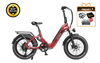
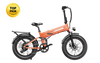
For example, many commuter and folding models in our Heybike electric bike collection ship configured for Class 2 or Class 3 assist depending on the model and settings—whereas off-road electric dirt bikes do not qualify under Texas e-bike rules—so always verify the permanent classification label and motor rating on the specific bike you plan to ride.
Do You Need a License, Registration, or Insurance in Texas?
No state driver's license, state motor-vehicle registration, or motor-vehicle liability insurance is required for a qualifying Class 1, Class 2, or Class 3 electric bicycle. Under Texas Transportation Code Section 551.107(a), Title 7 Subtitles A (vehicle titling and registration), B (driver licensing), and D (motor-vehicle financial responsibility/insurance), along with Chapter 551A (off-highway vehicles), do not apply to operating an electric bicycle. Likewise, Section 541.201(11) explicitly excludes electric bicycles from the definition of a "motor vehicle."
Important boundary: Those exemptions protect only bicycles that stay inside Section 664.001's pedal, wattage, and assisted-speed limits. If a two-wheeled electric vehicle falls outside that definition, it does not qualify for bicycle exemptions.
Age, Helmet, Passenger, and Equipment Rules
Age and Passenger Rules
- Class 3 minimum age: Under Section 551.107(c), a rider must be at least 15 years old to operate a Class 3 e-bike.
- Class 3 passengers: A person under 15 may ride as a passenger on a Class 3 e-bike if the bicycle is designed to carry more than one person.
- Class 1 and Class 2: Section 551.107(c) does not set a statewide minimum age for Class 1 or Class 2 e-bikes, though parents and guardians remain responsible under Section 551.101(b) for not knowingly permitting a child to violate traffic laws.
- Passenger capacity: Under Section 551.102(b), no bicycle—electric or regular—may carry more persons than it is designed or equipped to carry.
Helmet Rules: State Law vs. City Ordinances
Texas Transportation Code Chapters 551 and 664 do not impose a statewide bicycle or e-bike helmet requirement. However, Texas cities enforce their own helmet ordinances for minors:
- Austin: Under Austin City Code Section 12-2-31 and the city's Vision Zero guidance, riders and passengers age 17 and under must wear a bicycle helmet meeting U.S. CPSC standards.
- Dallas: Per Dallas City Hall's Bicycle Safety rules, minors under 18 are required by city law to wear a bicycle helmet.
Safety recommendation (not a statewide legal mandate for adults): Even where state or city law does not require one for adults, wearing a properly fitted CPSC-certified helmet is smart on every e-bike ride—especially at Class 3 commuting speeds.
Required Equipment, Lighting, and Labeling
To be operated legally on Texas roadways and paths, an e-bike must meet both operating and manufacturer/seller standards:
- Motor disengagement: Under Section 551.107(b), the motor must disengage or cease functioning either when the rider stops pedaling or when the brakes are applied.
- Brakes: Under Section 551.104(a), the bike must have a brake capable of making a braked wheel skid on dry, level, clean pavement.
- Nighttime lighting: Under Section 551.104(b), riding at nighttime requires a front white lamp visible from at least 500 feet, plus either a department-approved rear red reflector visible from 50 to 300 feet in front of lawful upper-beam headlights or a rear red lamp visible from 500 feet.
- One hand on handlebars & hand signals: Under Section 551.102(c) and TxDOT's Bicycle Laws FAQ, riders may not carry any object that prevents keeping at least one hand on the handlebars and must use standard hand signals when stopping or turning.
- Permanent class label & CPSC standards: Section 664.002 requires manufacturers and sellers to affix a permanent label (in at least 9-point Arial type) showing the e-bike's class, top assisted speed, and motor wattage. Section 664.003 requires compliance with federal CPSC bicycle standards (16 C.F.R. Part 1512), and Section 664.004 requires a speedometer on Class 3 e-bikes.
Where You Can Ride an E-Bike in Texas
Texas state law gives qualifying e-bikes broad access to public roads and paved municipal bicycle facilities, while leaving specific exceptions to TxDOT, local governments, and separate park or land-management agencies.
Streets, Roadways, and Bike Lanes
Under Section 551.106(a)(1)–(2), TxDOT or a local authority may not prohibit electric bicycles on a highway used primarily by motor vehicles, or in any area where nonelectric bicycles are allowed (subject to the natural-surface trail exception below). Under Sections 551.002 and 551.101, e-bike riders have the same rights and duties as motor-vehicle drivers unless a rule cannot apply by nature. On a roadway, Section 551.103 requires slower cyclists to ride as near as practicable to the right curb or edge—except when passing, turning left, avoiding roadway hazards, or riding in a lane less than 14 feet wide with no adjacent bike lane.
Paved Shared-Use Paths vs. Natural-Surface Trails
- Paved shared-use paths: Because regular bicycles are permitted, TxDOT or local authorities (such as cities and counties) cannot blanket-ban qualifying e-bikes from paved paths open to nonelectric bicycles under Section 551.106(a)(2). However, Section 551.106(b)(2) explicitly allows TxDOT or local authorities to set bicycle speed limits on shared-use paths—so a Class 3 bike capable of 28 mph assist must still obey a posted 15 mph or 20 mph path speed limit.
- Natural-surface trails: Under Section 551.106(a)(2)(A)–(B), TxDOT or local authorities may prohibit e-bikes on paths closed to motor vehicles that have a natural-surface tread made by clearing and grading native soil without added surfacing materials.
Sidewalks (City-by-City Differences)
Section 551.106(b)(1) allows TxDOT or a local authority to prohibit bicycles on sidewalks. Because state law leaves this to local control, rules vary by city:
- Austin: Austin City Code Section 12-2-13 generally allows riding on sidewalks in a reasonable and prudent manner, except on streets or sidewalks where riding is prohibited by signs or ordinance.
- Dallas: Dallas City Hall's Bicycle Safety page states that sidewalk riding is permitted outside the Central Business District, provided riders travel at walking speed and give care and room to pedestrians.
- Houston: Under City of Houston Ordinance No. 2025-1119 (Section 45-302), riding a bicycle on a sidewalk is prohibited within the central business district and wherever posted signs prohibit it; outside restricted zones, riders must yield to pedestrians and give an audible signal before passing.
Texas State Parks and Other Managed Lands
Separate from municipal street rules under Section 551.106, the Texas Parks and Wildlife Department (TPWD) Specialty Vehicles rules (effective January 2026) state that electric bicycles of all classes are allowed on state park roads where regular bicycles are permitted, but are not allowed on any state park trails. Federal lands, county parks, HOAs, and university campuses also maintain separate trail and parking rules, so always verify the managing agency's posted policy before riding.
High-Powered Bikes, Unlocked Speeds, and Electric Dirt Bikes
Not every two-wheeled electric bike sold online qualifies as an e-bike under Texas law. As Texas municipal police departments—including the Austin Police Department and the Town of Prosper—increasingly emphasize in public enforcement briefings, vehicles that exceed Section 664.001(4) are regulated very differently:
- No operable pedals, motor of 750W or more, or assisted speed over 28 mph: The vehicle is not a legal electric bicycle in Texas. Depending on its design, equipment, and where it is operated, it may fall under Texas definitions for a moped or motorcycle (Section 541.201(8)–(9)), or a pocket bike / off-highway vehicle (Section 551.351(2))—meaning it does not receive electric-bicycle exemptions and is governed by the rules applicable to that vehicle category.
- Throttle above 20 mph: Under Texas law, only Class 2 e-bikes may propel the bike without pedaling, and their top assisted speed is capped at 20 mph. A bike whose throttle propels it past 20 mph does not fit Class 1, Class 2, or Class 3.
- Software unlocks and label swaps: Section 664.002(b) requires anyone who alters a bike's motor-powered speed capability or engagement to replace the permanent class label with accurate information. Changing a display setting or adding a Class 2/3 sticker does not make an over-wattage or pedal-less electric dirt bike street-legal on Texas bike lanes or trails.
How to Check Local Rules for Your City or Route
Because Texas combines statewide baseline protections with local authority over sidewalks, helmets, path speed limits, and natural-surface trails, confirm your route in three quick steps:
-
Check your city's municipal code or transportation page: Search
[Your City] Texas bicycle ordinanceor check your city's Transportation / Parks & Recreation website for downtown sidewalk bans, minor helmet ordinances, and urban trail speed limits. - Identify the trail or park manager: A greenbelt or dirt trail inside city limits may be managed by the city parks department, a county, or TPWD—each with different rules for Class 1–3 e-bikes.
- Inspect your bike's permanent label: Confirm the motor wattage (under 750W), operable pedals, and Class 1/2/3 top assisted speed before riding on public roads or paths.
Frequently Asked Questions
Can I ride a Class 3 e-bike on a paved trail in Texas?
State law (Section 551.106(a)(2)) prevents TxDOT or local authorities from banning e-bikes on paved paths open to regular bicycles, except that they may set bicycle speed limits under Section 551.106(b)(2) and Texas State Parks prohibit all e-bike classes on park trails. Always obey posted path speed limits.
What happens if I ride an electric dirt bike or 1,000W+ bike on Texas streets or bike lanes?
Because a motor of 750W or higher, a lack of operable pedals, or assisted speeds over 28 mph place a vehicle outside Section 664.001(4), it does not receive bicycle exemptions under Section 551.107(a). How it is cited or restricted depends on the vehicle's classification and local enforcement—for example, Austin PD enforces motor-vehicle registration, insurance, and trail/sidewalk restrictions against qualifying "e-motos."
Are visitors from other states bound by Texas age and helmet rules?
Yes. Traffic and equipment laws apply based on where you ride, not where you live or bought the bike—so out-of-state visitors must meet Texas's age-15 minimum for Class 3 e-bikes and any local city helmet or sidewalk ordinances on their route.
Share:
New Electric Bike Laws 2026 for New York
How to Reset an E-Bike Controller
1 comment
I’m thankful for this article because we were decided for a bike riding in the neighborhood. I want to find out what can we do to make it street legal.