

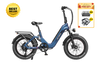
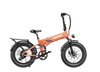

Heybike and Aventon both offer fat-tire electric bikes designed for riders who want more capability than a basic city ebike. The Heybike Mars 3.0 and Aventon Aventure 3 are particularly comparable because both use 750W rear hub motors, 4-inch-wide tires, torque sensing, hydraulic disc brakes, and a claimed range of up to 65 miles.
The biggest difference is how each bike is built around those features. The Mars 3.0 combines a folding frame, 20×4-inch fat tires, full suspension, and 95 N·m of torque in a more compact format. The Aventure 3 uses a full-size 26×4-inch platform, an 80mm suspension fork, a suspension seatpost, a 733Wh battery, and Aventon's ACU connected-bike system with GPS and 4G capabilities.
This comparison focuses on the differences that matter when choosing between the two: design, motor performance, suspension, battery and range, storage, technology, carrying capacity, warranty, and everyday use.
Same category, different priorities
Mars 3.0 is the more compact, folding and suspension-focused choice. Aventure 3 favors a full-size platform, a larger battery and deeper connected security features.
Mars 3.0 vs Aventure 3 at a Glance
| Feature | Heybike Mars 3.0 | Aventon Aventure 3 |
|---|---|---|
| Current listed price | $1,199 | $1,999 |
| Motor | 750W rear hub | 750W rear hub |
| Peak power | 1,400W | 1,440W in Boost Mode |
| Torque | 95 N·m | 80 N·m |
| Battery | 624Wh | 733Wh |
| Claimed range | Up to 65 miles | Up to 65 miles |
| Tire size | 20×4.0" | 26×4.0" |
| Suspension | Front + rear | Front suspension fork + suspension seatpost |
| Suspension fork travel | 65mm | 80mm |
| Torque sensing | Yes | Yes, with Sensor Switch |
| Folding frame | Yes | No |
| Weight | 70 lb | 76 lb |
| Maximum total weight | 440 lb | 400 lb |
| Included rack | Yes | Yes |
| Included fenders | Yes | Yes |
| Connected features | Heybike App, NFC, TFT display | ACU, 4G/GPS, Ride Tune, anti-theft features |
| Charger | 2A | 4A |
| Approx. charging time | 5–7 hours | 5 hours |
| Warranty | 2 years | 2 years for specified covered components; battery coverage is 2 years or 300 cycles |
Specifications are based on the manufacturers' current product and warranty information. Prices are subject to change.
Two Different Takes on the Fat-Tire Ebike

Both bikes belong to the same broad category, but they solve different problems.
The Mars 3.0 is built around a combination that is less common in the category: a folding frame, 20×4-inch fat tires, and front-and-rear suspension. It is designed for riders who want the traction and comfort of a fat-tire ebike while retaining the ability to fold the bike for storage and transportation. Heybike also gives it a 440-pound combined rider-and-cargo capacity.
The Aventure 3 takes a traditional full-size approach. It uses 26×4-inch tires, an 80mm suspension fork, and a 50mm suspension seatpost. It is available in Regular and Large frame sizes, covering riders from approximately 5'3" to 6'4" according to Aventon's current fit information.
That distinction is important. The Mars 3.0 puts more of its design emphasis on compactness, suspension coverage, and folding versatility, while the Aventure 3 focuses on a full-size wheel platform, integrated connected technology, and all-terrain riding.
Motor, Torque, and Power
Both models use 750W rear hub motors, so motor wattage alone does not create a major difference between them.
The Mars 3.0 produces up to 1,400W of peak power and is rated at 95 N·m of torque. Its torque sensor adjusts assistance based on how much pressure the rider puts into the pedals, while the bike provides five riding modes and app-based motor customization.
The Aventure 3 also uses a 750W rear hub motor, with up to 1,440W available in Boost Mode and 80 N·m of listed torque. Aventon's Sensor Switch allows riders to choose between torque-sensing and cadence-sensing operation.
On the published specifications, the Mars 3.0 has the higher listed torque figure, while the Aventure 3 has a slightly higher peak-power figure in Boost Mode. Neither number alone determines how an ebike will feel on the road. Wheel size, gearing, controller tuning, rider weight, terrain, and pedal-assist response all affect acceleration and climbing.
Independent testing also reflects the performance-oriented design of both bikes. Electric Bike Review described the Mars 3.0 as unusually powerful for a folding ebike, highlighting its 1,400W peak output and 95 N·m of torque. Its Aventure 3 review described the Aventon motor as smooth and quiet while highlighting the bike's redesigned frame and connected technology.
Tires and Suspension

This is one of the clearest hardware differences.
The Mars 3.0 uses 20×4-inch fat tires with full suspension. Its front hydraulic suspension fork provides 65mm of travel, while the rear uses a Horst Link suspension system. The combination gives the bike suspension at both ends without giving up its folding frame.
The Aventure 3 uses 26×4-inch fat tires, an 80mm suspension fork, and a 50mm suspension seatpost. This provides front suspension plus additional cushioning at the seat, but it is a different layout from the Mars 3.0's front-and-rear suspension.
The tire-size difference also reflects the different frame designs. The Mars 3.0's 20-inch wheels help support its folding format and compact footprint. The Aventure 3's larger 26-inch wheels are part of a conventional full-size platform.
For riders who frequently encounter potholes, cracked pavement, gravel, or light trails, both fat-tire configurations provide additional tire volume compared with standard-width ebike tires. The more important question is whether you want the compact folding format and full suspension of the Mars 3.0 or the larger-wheel platform of the Aventure 3.
Battery and Range
The Mars 3.0 uses a removable 624Wh battery and offers up to 65 miles of range on a single charge. The included 2A charger takes approximately five to seven hours for a full charge.
The Aventure 3 uses a larger 733Wh battery and is also rated for up to 65 miles of range. Aventon lists a five-hour charging time with the included charger.
The same maximum range figure does not mean the bikes will deliver the same distance in every situation. Actual range depends on rider and cargo weight, assist level, throttle use, terrain, speed, temperature, wind, tire pressure, and other conditions.
Independent testing of the Aventure 3 demonstrates how much riding conditions can change the result. Electric Bike Review recorded 34 miles at maximum pedal assist and 62 miles at minimum assist during its testing. Those results are specific to that test setup, but they illustrate why maximum advertised range should be treated as a reference rather than a guaranteed distance.
The Mars 3.0 has the smaller battery capacity on paper, but it combines that battery with a folding frame, 20×4-inch tires, and a more compact overall format. The Aventure 3 pairs its larger battery with a full-size 26-inch platform and its connected-bike technology.
Folding Design and Transportation

For many buyers, this is the decision point that matters most.
The Mars 3.0 is a folding fat-tire ebike. It folds to approximately 38.2 × 19.7 × 33.1 inches, according to Heybike, and weighs 70 pounds.
The folding design can be useful for riders with limited storage space, including those storing a bike in a garage, apartment, RV, or vehicle cargo area. It can also make it easier to reduce the bike's footprint when it is not being ridden.
That convenience comes with a tradeoff: at 70 pounds, the Mars 3.0 is still a substantial ebike. Folding does not make it an ultralight bike, so riders who regularly need to carry an ebike upstairs should consider its weight as well as its folded dimensions.
The Aventure 3 does not fold and weighs 76 pounds according to Aventon's current specifications. It is designed as a full-size bike with Regular and Large frame options.
For riders who rarely transport an ebike, the folding mechanism may not be especially important. For riders who regularly need to fit an ebike into a smaller storage area, the difference between a folding and non-folding frame is much more significant than a small difference in motor output.
Rider Fit and Carrying Capacity
The two bikes also differ in how they approach fit and payload.
The Mars 3.0 uses a compact folding format and has a 440-pound maximum combined rider-and-cargo weight limit. Its included rear rack is rated to carry up to 100 pounds within the overall weight limit.
The Aventure 3 has a 400-pound total weight limit and is offered in Regular and Large frame sizes. Aventon lists the Regular size for riders approximately 5'3" to 5'10" and the Large size for approximately 5'10" to 6'4".
That means the decision is not simply about maximum weight. Riders should also consider whether they prefer a one-size folding platform or a full-size frame with multiple sizing options.
For carrying groceries, work equipment, camping gear, or other cargo, both bikes include rear racks and fenders from the factory.
Smart Features and Connected Technology
The two bikes offer app-connected features, but their technology focuses on different areas.
The Mars 3.0 includes a color TFT display, NFC startup, and Heybike App connectivity. The app allows riders to customize motor response and manage certain settings, while NFC provides a tap-based startup option. The bike also supports over-the-air updates.
The Aventure 3 goes further into connected security and tracking. Its Aventon Control Unit supports 4G and GPS features, including location tracking, geofencing, motion detection, remote functions, and status reporting. Aventon also includes Ride Tune customization, Apple Watch connectivity, over-the-air updates, and a keyless battery system.
For riders who mainly want app controls, NFC access, and adjustable ride settings, the Mars 3.0 provides a relatively straightforward connected setup. Riders who specifically value GPS tracking, cellular connectivity, and integrated anti-theft functions may place more importance on the Aventure 3's ACU system.
Everyday Equipment
Both bikes come equipped for everyday riding rather than requiring a long list of accessories before the first ride.
The Mars 3.0 includes front and rear fenders, a rear rack, a front light with horn, and a rear light with brake and turn signals. It also uses an eight-speed Shimano Altus drivetrain and hydraulic disc brakes.
The Aventure 3 includes front and rear lights, fenders, a rear rack, hydraulic disc brakes, and an eight-speed Shimano Altus drivetrain.
The major difference is less about whether either bike is equipped for daily use and more about the form those features take. The Mars 3.0 combines utility equipment with a folding frame and full suspension, while the Aventure 3 integrates its equipment into a larger full-size platform.
Price, Warranty, and Service
At the time of writing, the Mars 3.0 is listed at $1,199 on Heybike's website. The Aventure 3 is listed at $1,999 on Aventon's current product and Aventure collection pages. Prices and promotions may change, so verify the current price before purchasing.
Heybike provides a two-year warranty for e-bikes purchased through its official website, excluding normal wear-and-tear items.
Aventon's current warranty provides two years of coverage for specified frame, drivetrain, electrical, and wheel components. The original purchaser can extend structural frame and frameset coverage to a lifetime warranty by registering the product within 90 days of the original purchase. Aventon lists battery coverage as two years or 300 charging cycles, whichever comes first. Other covered component parts have different warranty periods.
This is worth considering alongside the hardware. A lower purchase price may matter most to one buyer, while local test rides and service access may matter more to another.
What Independent Reviews Highlight
Independent reviews can provide useful context beyond manufacturer specifications.
For the Mars 3.0, Electric Bike Review emphasized the unusual combination of full suspension, folding design, 20×4-inch tires, and strong motor output, describing it as a high-powered folding ebike with more off-road capability than a typical folder.
For the Aventure 3, Electric Bike Review highlighted the redesigned gravity-cast frame, larger 26-inch fat tires, smooth motor response, and Aventon's connected ACU technology. The review also noted that the 76–78 pound range makes the bike substantial to lift and maneuver when power assistance is unavailable.
These observations are consistent with the broader product designs: Mars 3.0 puts unusual emphasis on combining folding convenience with suspension and power, while Aventure 3 emphasizes a full-size fat-tire platform with connected technology and multiple frame sizes.
Which Bike Fits Your Riding Style?
The most useful way to compare these bikes is to start with the features you will use most often.
Mars 3.0 may fit riders who prioritize:
- A folding frame for storage or transportation
- Full suspension in a fat-tire ebike
- 20×4-inch tires
- A higher listed torque rating
- A 440-pound combined rider-and-cargo limit
- A more compact frame format
- NFC startup and app-based motor customization
- A lower current listed price
The main tradeoff is weight. Although the Mars 3.0 folds, its 70-pound weight means it is still a substantial bike to lift and carry.
Aventure 3 may fit riders who prioritize:
- A full-size 26×4-inch wheel platform
- A larger 733Wh battery
- Multiple frame sizes
- 4G/GPS connectivity
- Integrated anti-theft and tracking features
- Ride Tune and Sensor Switch
- Local dealer and service availability
- A more conventional full-size fat-tire ebike format
The main tradeoffs are the higher purchase price and the lack of a folding frame. At 76 pounds, the Aventure 3 is also not a lightweight bike.
Mars 3.0 vs Aventure 3: Which One Should You Choose?
The biggest differences come down to price, bike format, and features. At the time of writing, the Mars 3.0 is $1,199, while the Aventure 3 is $1,999, a difference of $800.
The Mars 3.0 combines 20×4-inch fat tires, full suspension, folding capability, and 95 N·m of torque. The Aventure 3 offers a full-size 26×4-inch platform, a larger battery, multiple frame sizes, and integrated 4G/GPS and anti-theft features.
The right choice depends on which differences matter most to you: the Mars 3.0 puts more emphasis on folding versatility and full suspension, while the Aventure 3 puts more emphasis on a full-size platform, connected technology, and frame options.
Frequently Asked Questions
Is the Mars 3.0 a folding fat-tire ebike?
Yes. The Mars 3.0 combines a folding frame with 20×4-inch fat tires, front-and-rear suspension, and a torque sensor. It weighs 70 pounds and supports up to 440 pounds of combined rider and cargo weight.
How does the Mars 3.0 compare with the Aventure 3?
Both are fat-tire electric bikes with 750W rear hub motors, torque sensing, hydraulic disc brakes, and claimed ranges of up to 65 miles. The Mars 3.0 adds folding capability and full suspension with 20×4-inch tires, while the Aventure 3 uses a full-size 26×4-inch platform, front suspension, a suspension seatpost, and a larger 733Wh battery.
Which has the larger battery?
The Aventure 3 has the larger battery at 733Wh, compared with 624Wh for the Mars 3.0. Both are rated for up to 65 miles of range under their respective manufacturers' stated conditions.
Which has more motor torque?
The Mars 3.0 is listed at 95 N·m, while the Aventure 3 is listed at 80 N·m. Torque is only one part of an ebike's performance; wheel size, gearing, rider weight, terrain, controller behavior, and battery state can all influence how the bike accelerates and climbs.
Which has larger tires?
The Aventure 3 uses 26×4-inch tires, while the Mars 3.0 uses 20×4-inch tires. The smaller wheels on the Mars 3.0 support its folding design, while the Aventure 3's larger wheels are part of its full-size frame platform.
Does the Aventure 3 have full suspension?
The Aventure 3 has an 80mm front suspension fork and a 50mm suspension seatpost. The Mars 3.0 uses both front and rear suspension, so the two bikes use different suspension configurations.
Which bike is easier to store?
The Mars 3.0 has a folding frame and published folded dimensions of approximately 38.2 × 19.7 × 33.1 inches. The Aventure 3 does not fold. Storage space is therefore one of the clearest practical differences between the two bikes.
Do both bikes have connected features?
Yes, but the focus is different. The Mars 3.0 offers Heybike App connectivity, NFC startup, TFT display functions, and OTA updates. The Aventure 3 adds ACU-based 4G/GPS, geofencing, tracking, anti-theft features, Ride Tune, Apple Watch connectivity, and OTA updates.
How do the warranties compare?
Heybike provides a two-year warranty for e-bikes purchased through its official website, excluding normal wear and tear. Aventon's current warranty provides two years for specified covered components, while the original purchaser may extend structural frame coverage to a lifetime warranty by registering within 90 days; battery coverage is two years or 300 charging cycles, whichever comes first.
What should I compare besides motor power?
Look at the complete configuration: wheel size, suspension, battery capacity, folding design, rider fit, payload, braking, connected features, warranty, service access, and how the bike will actually be stored and used. A 750W motor does not make two ebikes interchangeable when the rest of the bike is designed for different riding priorities.
Final Takeaway
The Heybike Mars 3.0 and Aventon Aventure 3 share the same broad fat-tire ebike category, but they are built around different priorities.
The Mars 3.0 combines a folding frame, 20×4-inch fat tires, full suspension, 95 N·m of torque, a 440-pound total load limit, and a current listed price of $1,199. The Aventure 3 combines a full-size 26×4-inch platform, 733Wh battery, 80 N·m of torque, connected ACU technology, multiple frame sizes, and a current listed price of $1,999.
For riders comparing Heybike vs Aventon, the clearest starting point is not a single score or ranking. Consider how much you value folding storage, full suspension, wheel size, battery capacity, connected features, payload, price, and local service. Those factors determine which configuration makes more sense for your own riding.




Share:
Heybike Mars 3.0 Battery Unlock & Startup Guide