



Folding fat-tire e-bikes are expected to do several jobs at once. They need enough power for hills, enough comfort for rough pavement, enough range for longer rides, and a frame that can still fit into a garage, RV, or vehicle. The Heybike Mars 3.0 and Lectric XP4 750 Long-Range approach that brief from different directions.
Both are torque-sensor folding e-bikes with 750W nominal motors, hydraulic brakes, and integrated displays. The deciding differences are not found in a single headline number. Mars 3.0 emphasizes suspension comfort, traction, payload, and value, while XP4 750 Long-Range prioritizes battery capacity, cargo-rack capacity, and a smaller folded footprint.
Quick Take
Choose the Heybike Mars 3.0 if you want full suspension, 4-inch fat tires, stronger published peak motor, a higher total payload rating, and a two-year warranty at a lower current list price.
Choose the Lectric XP4 750 Long-Range if maximum claimed range, a 150-pound rear-rack rating, and more compact folded dimensions matter more than rear suspension or extra tire volume.
Prices and promotions can change. At the time of writing, Mars 3.0 is listed at $1,199 and the XP4 750 Long-Range at $1,299. Always confirm the current configuration and included accessories before ordering.
Mars 3.0 vs XP4 750 Long-Range: Key Specifications
| Specification | Heybike Mars 3.0 | Lectric XP4 750 Long-Range |
|---|---|---|
| Current listed price* | $1,199 | $1,299 |
| Motor | 750W nominal, 1,400W peak | 750W nominal, 1,310W peak |
| Published torque | 95 N·m | 85 N·m |
| Battery | 624Wh | 840Wh |
| Claimed maximum range | Up to 65 miles | Up to 85 miles |
| Top assisted speed | Up to 28 mph | Up to 28 mph |
| Pedal sensor | Torque sensor | Torque sensor |
| Suspension | 65mm front fork and Horst-link rear suspension | Front suspension fork |
| Tires | 20 × 4.0 in | 20 × 3.0 in |
| Brakes | Hydraulic disc brakes | Hydraulic disc brakes, 180mm rotors |
| Published bike weight | 70 lb | 62 lb without battery; battery adds 9 lb |
| Maximum total payload | 440 lb | 330 lb |
| Rear-rack capacity | 100 lb | 150 lb |
| Folded dimensions | 38.2 × 19.7 × 33.1 in | 37 × 17 × 29 in |
| Electrical certification | UL 2849; battery UL 2271 | UL 2849; battery UL 2271 |
| Manufacturer warranty | 2 years | 1 year |
*Prices and promotions shown at the time of writing.
Price and What You Get
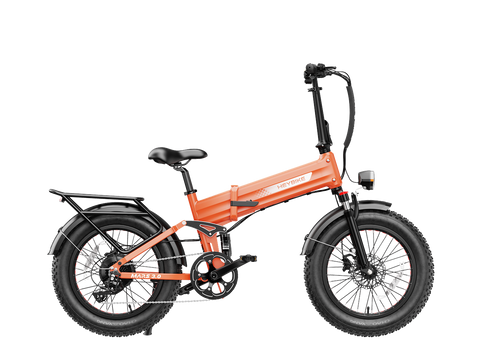
The price gap is modest, but the hardware priorities are noticeably different. At its current price, the Heybike Mars 3.0 includes front and rear suspension, 4-inch tires, fenders, and a rear rack. Its published peak output and torque are also higher than the XP4 750 Long-Range figures.
Lectric directs more of the XP4 Long-Range budget toward its 840Wh battery and utility-oriented rear rack. It also includes fenders and a rear rack, while its compact folded size can be meaningful for apartment dwellers or RV owners.
This makes the value question use-specific. Mars 3.0 provides more ride-comfort and all-terrain hardware per dollar. XP4 750 Long-Range asks slightly more but gives riders a larger battery and a rack rated for heavier cargo.
Motor Performance and Hill-Climbing
Both bikes use 750W nominal hub motors and torque sensors, so neither should feel like an old-fashioned cadence-only folder that abruptly switches assistance on and off. A torque sensor responds to how hard the rider pedals, generally making low-speed starts and changes in assistance feel more proportional.
On paper, Mars 3.0 has the stronger performance numbers: 1,400W peak output and 95 N·m of torque, compared with 1,310W peak and 85 N·m for the XP4 750 Long-Range. That advantage may be useful for heavier riders, steeper grades, or frequent stop-and-go riding with cargo.
Published motor figures do not guarantee identical real-world acceleration. Controller tuning, battery charge, rider weight, temperature, tire pressure, and the selected assist level all affect how a bike performs. Riders should treat the numbers as a useful comparison of manufacturer specifications, not a substitute for riding both bikes.
Battery and Real-World Range
Battery capacity is the clearest XP4 advantage. Its 840Wh long-range battery is substantially larger than the Mars 3.0's 624Wh battery. Lectric advertises up to 85 miles for this configuration, while Heybike lists up to 65 miles for Mars 3.0.
Those are maximum claimed figures achieved under favorable conditions. Hills, cold weather, frequent starts, soft surfaces, higher assist levels, throttle use, cargo, and low tire pressure can reduce range. The 20-mile difference between the two advertised maximums should therefore be viewed as a directional advantage rather than a guaranteed gap on every ride.
For riders who regularly plan long, mostly paved trips and want more energy in reserve, the XP4 750 Long-Range is the stronger fit. For mixed urban rides where 65 miles of claimed maximum range already exceeds a typical day, Mars 3.0 may offer a better balance between battery capacity and chassis features.
Suspension, Tires, and Ride Comfort

Mars 3.0 combines a 65mm suspension fork with Horst-link rear suspension. That rear system is the biggest chassis distinction in this comparison. It helps isolate the rider from repeated bumps that would otherwise pass through a rigid rear frame, especially on broken pavement, gravel connectors, curb transitions, and uneven park paths.
Its 20 × 4.0-inch tires also provide more air volume and a broader contact patch than the XP4's 20 × 3.0-inch tires. The wider setup favors traction and cushioning, although it can feel heavier to steer and may create more rolling resistance. Riders comparing other wide-tire options can also browse Heybike's fat-tire electric bike collection.
The XP4 uses a suspension fork but no rear suspension. Its 3-inch tires are still much wider than conventional city-bike tires and can handle poor pavement and light unpaved use. They may feel a little more agile on smooth streets, but riders who prioritize bump absorption are likely to prefer the Mars chassis.
Neither model should be treated as a downhill mountain bike. Their folding frames, hub motors, and utility equipment are designed for versatile everyday riding rather than jumps or aggressive technical trails.
Folding Size, Weight, and Transport
The two bikes are closer in riding weight than the published figures initially suggest. Heybike lists Mars 3.0 at 70 pounds. Lectric lists the XP4 at 62 pounds without its 9-pound battery, which puts the complete bike at roughly 71 pounds. In practice, either bike is substantial to lift into a vehicle, and removing the battery first can make handling easier.
XP4 has the advantage once folded. Its listed dimensions are 37 × 17 × 29 inches, compared with 38.2 × 19.7 × 33.1 inches for Mars 3.0. A few inches can determine whether a folded bike fits beneath a shelf or inside a particular trunk, so measure the intended storage space instead of relying on the word “folding” alone.
If compact storage is a primary requirement, compare frame dimensions across the wider folding electric bike collection before choosing. Owners should also secure the folded bike during transport and avoid lifting it by the display, cables, or folding latch.
Payload and Cargo Utility
Mars 3.0 has the higher total payload rating: 440 pounds versus 330 pounds for the XP4. Total payload includes the rider and everything carried on the bike, so the extra allowance can be relevant for larger riders or anyone carrying substantial gear.
XP4 reverses the result at the rear rack. Lectric rates its rack for up to 150 pounds, while the Mars rack is rated for 100 pounds. That makes XP4 especially attractive to riders building a cargo-focused setup, provided the combined rider-and-cargo load remains within the bike's 330-pound total limit.
Rack capacity and total capacity should never be treated as interchangeable. A 150-pound rack rating does not allow the complete bike to exceed its stated 330-pound payload, and load distribution affects handling. Heavy cargo should be secured low and evenly, with braking distance and turning speed adjusted accordingly.
Controls, Display, and Safety Equipment
Both bikes use color displays and hydraulic disc brakes. Mars 3.0 adds NFC unlocking, while XP4 includes a USB-C charging port and offers adjustable Class 1, 2, and 3 operation. Both can provide assistance up to 28 mph when configured for Class 3 use.
Local e-bike rules vary. Some paths and trails do not permit Class 3 operation or throttle use, so riders should configure the bike for the area where it will be used. A helmet, routine brake inspection, correct tire pressure, and a pre-ride folding-latch check are more important than any single display feature.
Both products state compliance with UL 2849, and both battery systems are listed to UL 2271. These certifications address electrical-system safety standards; they do not remove the need to use the supplied charger, keep charging equipment dry, and replace damaged batteries through an authorized channel.
Warranty and Long-Term Ownership
Heybike currently provides a two-year limited warranty for Mars 3.0. Lectric lists a one-year manufacturer warranty for XP4.
Before purchasing, read the current policy rather than relying only on the duration. Keep the order record and serial number, follow battery-storage guidance, and document any issue promptly. Consumable parts such as brake pads and tires are normally treated differently from defects in covered components.
Which Bike Fits Your Riding Style?
Choose Heybike Mars 3.0 if you:
- Ride broken pavement, gravel connectors, or uneven neighborhood routes where rear suspension adds comfort.
- Want 4-inch tires for extra traction and cushioning.
- Prefer the higher published peak power and torque figures.
- Need a higher total payload rating.
- Value a two-year warranty and the lower current listed price.
Choose Lectric XP4 750 Long-Range if you:
- Put maximum battery capacity and claimed range first.
- Need a rear rack rated for up to 150 pounds.
- Have a tight storage space where the smaller folded dimensions matter.
- Prefer slightly narrower tires for predominantly paved riding.
- Want the XP4's USB-C port and its specific control layout.
Frequently Asked Questions
Which bike has more range?
The Lectric XP4 750 Long-Range has the larger battery at 840Wh and the higher advertised maximum of 85 miles. Mars 3.0 uses a 624Wh battery and is advertised for up to 65 miles. Actual range for either bike depends on rider and cargo weight, terrain, weather, tire pressure, assist level, and throttle use.
Which bike is better for rough roads?
Mars 3.0 has the stronger comfort-focused specification because it combines front suspension, Horst-link rear suspension, and 4-inch tires. XP4 has a suspension fork and 3-inch tires, which remain suitable for urban imperfections and light unpaved surfaces.
Are these bikes easy to carry when folded?
They fold for storage, but neither is lightweight. Mars 3.0 is listed at 70 pounds, while the XP4 is approximately 71 pounds with its battery installed. Removing the battery can help, but many riders will still use two people or a ramp when loading either bike.
Which one is better for carrying cargo?
It depends on the load. Mars 3.0 supports a higher total payload of 440 pounds. XP4 has a higher rear-rack rating of 150 pounds, but its complete rider-and-cargo load must remain within the 330-pound total rating.
Can both bikes reach 28 mph?
Both are advertised for assisted speeds up to 28 mph when configured appropriately. Legal access and permitted e-bike classes vary by location, trail, and path, so riders should check local rules.
Final Takeaway
Mars 3.0 is the comfort-and-capability choice: full suspension, 4-inch tires, stronger published motor figures, a 440-pound payload rating, and a longer warranty at a lower current price. XP4 is the range-and-cargo specialist: a larger 840Wh battery, a higher advertised maximum range, a 150-pound rack rating, and a smaller folded package.
The better bike is the one whose strengths match the rides you actually take. Measure your storage space, estimate your typical rider-and-cargo load, and compare realistic daily mileage rather than shopping by a single maximum figure. To see how these models fit into other frame styles and use cases, visit Heybike or explore the full electric bike collection.


Share:
Heybike vs Velotric: Ranger 3.0 Pro vs Fold 1 Plus
Heybike Hybrid Plays the Long Game