


Last reviewed: August 25, 2026
Electric bike laws in the United States are not one-size-fits-all. Requirements can change from one state to another—and sometimes between cities, counties, parks, and individual trail systems.
Before riding, it is important to know how your e-bike is classified, whether helmet or age requirements apply, and where your e-bike is permitted.
This guide explains the main rules riders should check in 2026. It provides general educational information and is not legal advice. Always confirm current requirements with the appropriate state or local government and the agency responsible for the road, path, park, or trail where you plan to ride.
Four Questions to Check Before You Ride
You do not need to memorize every state law. Start by answering these four questions:
- What class is your e-bike in its current configuration?
- Do age, helmet, license, registration, or insurance requirements apply?
- Does the city or county permit your e-bike on sidewalks and shared-use paths?
- Does the park or trail manager allow your class of e-bike?
Answering these questions will help you identify the rules most likely to affect your ride.
Federal Rules and State Riding Laws Are Different
For federal consumer-product safety purposes, a low-speed electric bicycle is generally defined as a two- or three-wheeled vehicle with fully operable pedals, an electric motor of less than 750 watts, and a motor-only speed of less than 20 MPH under specified test conditions.
This federal definition primarily concerns product safety. It does not establish one nationwide set of traffic, helmet, sidewalk, or trail-access rules.
States determine how e-bikes are classified and operated. Cities, counties, parks, and land-management agencies may impose additional restrictions.
Official reference: U.S. Consumer Product Safety Commission Bicycle Requirements
Understanding the Common Three-Class System
Many states use a version of the Class 1, Class 2, and Class 3 system. Exact definitions and access rules may still differ by state.
Class 1
- The motor provides assistance only while the rider is pedaling.
- Motor assistance stops at 20 MPH.
Class 2
- The motor may propel the bicycle without pedaling.
- Motor assistance stops at 20 MPH.
Class 3
- Generally uses pedal assistance.
- Motor assistance stops at 28 MPH.
- May be subject to additional age, helmet, equipment, and path-access requirements.
A class label is a useful starting point, but riders should always confirm the definition used by their state.
Rules That Commonly Vary
Helmet and Minimum-Age Requirements
There is no single nationwide helmet or minimum-age rule for e-bike riders.
Requirements may depend on:
- The rider’s age
- The e-bike’s class
- Whether the person is an operator or passenger
- The type of road, path, or trail being used
Even where a helmet is not legally required, Heybike recommends wearing a properly fitted bicycle helmet on every ride.
License, Registration, and Insurance
License, registration, and insurance requirements vary by jurisdiction. Do not assume that an e-bike is exempt simply because it has pedals or is sold as an electric bicycle.
If a vehicle exceeds the applicable legal definition, it may be treated as a moped, motorized bicycle, motorcycle, or another type of motor vehicle.
New Jersey and Hawaii are two important examples of states with e-bike registration requirements. Riders should check the current process with the responsible state agency.
Sidewalks, Bike Paths, Parks, and Trails
A street-legal e-bike is not automatically allowed on every sidewalk, bike path, park, or trail.
Access may depend on:
- The e-bike’s class
- State and local traffic laws
- Posted speed limits
- Whether the route is paved or natural-surface
- Rules established by a park or trail manager
Always follow posted signs and check the agency responsible for the specific route before riding.
Important E-Bike Law Updates for 2026
The following changes have been confirmed through official state sources. Effective dates matter—a law may have been passed before it becomes enforceable.
California — Effective January 1, 2026
California requires an electric bicycle, during all hours of operation, to have the required rear red reflector or qualifying solid or flashing red light with a built-in reflector.
California also introduced updated testing, labeling, and documentation requirements affecting electric bicycles and storage batteries offered for sale.
Official references:
Washington — Effective June 11, 2026
Washington updated its electric bicycle definition.
A vehicle capable of motor-only operation above 20 MPH—or designed to be easily configured outside the state’s e-bike requirements through software, an app, a switch, or another method—may not qualify as an electric bicycle.
Official reference: Washington SB 6110
Tennessee — Effective July 1, 2026
A person under 16 may not operate a Class 3 electric bicycle on a street or highway.
Class 3 access to certain paths and trails may also depend on the location and the authority responsible for that route.
Official reference: Tennessee HB 1712
New Jersey — Effective July 2026
New Jersey requires e-bikes to be registered with the Motor Vehicle Commission.
Operators generally must be at least 15 years old and have either an e-bike license or a valid driver’s license. Insurance is required for motorized bicycles, but qualifying low-speed electric bicycles do not require insurance. Both categories must be registered.
Official reference: New Jersey MVC E-Bike Requirements
Hawaii — Effective July 15, 2026
Hawaii enacted a statewide framework that updates e-bike definitions, registration requirements, age-related standards, helmet rules, product labeling, and operating requirements.
Local restrictions and rules for specific facilities may still apply.
Official reference: Hawaii Department of Transportation—Act 259
North Carolina — Effective December 1, 2026
North Carolina’s new three-class definitions and related helmet and local-access provisions become effective on December 1, 2026.
Until that date, riders should continue following the rules currently in effect.
Official reference: North Carolina Session Law 2026-46
Be Careful With Speed Unlocking and Modifications
An e-bike’s legal status is based on how it operates in its current configuration—not only on the class printed on its original label.
Changing the controller, motor, throttle, software, pedals, or speed settings may cause the vehicle to fall outside its original e-bike class.
The modified vehicle may then face different:
- Registration requirements
- Licensing requirements
- Equipment rules
- Insurance requirements
- Road and trail restrictions
A setting intended for private property or off-road use is not automatically legal on public streets, sidewalks, or bike paths.
Always use a configuration permitted in the location where you ride.
Your Five-Minute Pre-Ride Checklist
Before riding in a new state, city, park, or trail:
- Confirm your e-bike’s class and current speed configuration.
- Check age and helmet requirements.
- Check license, registration, and insurance rules.
- Review local sidewalk and shared-use path restrictions.
- Confirm the specific park or trail access policy.
- Inspect your helmet, brakes, lights, tires, and reflectors.
- Follow posted signs and local speed limits.
More State E-Bike Guides
The following Heybike articles provide additional background on selected states:
- California E-Bike Laws
- Florida E-Bike Laws
- Illinois E-Bike Laws
- Michigan E-Bike Laws
- New York E-Bike Laws
- Ohio E-Bike Laws
- Pennsylvania E-Bike Laws
These guides are a starting point for general information. For the most current legal requirements, confirm the rules through the applicable state agency, state legislature, local government, or facility manager.
Frequently Asked Questions
Do I need a license to ride an e-bike?
It depends on the state and how the vehicle is classified. Some jurisdictions do not require a license for qualifying e-bikes, while others impose operator licensing requirements.
If your e-bike exceeds the state’s legal definition, different motor vehicle rules may apply.
Do electric bikes need to be registered?
Registration requirements vary by state. New Jersey and Hawaii require qualifying e-bikes to be registered under their current state rules.
Always check the responsible state motor vehicle or transportation agency.
Do I have to wear a helmet?
Helmet requirements may depend on the rider’s age and the e-bike’s class. Some states apply additional helmet rules to younger riders or Class 3 operators.
Heybike recommends wearing a properly fitted bicycle helmet on every ride.
Can I ride an e-bike on the sidewalk?
It depends on state and local law. Sidewalk rules may vary between cities in the same state and may also depend on the e-bike’s class or the type of district.
Check local rules before riding on a sidewalk.
Can I ride an e-bike on bike paths or trails?
Access depends on the e-bike class and the agency responsible for the path or trail.
Paved transportation paths, natural-surface trails, parks, and federal lands may follow different policies. Check the managing agency and follow posted signs.
Is a 28 MPH e-bike legal?
A pedal-assist e-bike that stops providing assistance at 28 MPH may qualify as Class 3 in states that recognize that framework.
Class 3 e-bikes may face additional age, helmet, equipment, sidewalk, and trail restrictions. Motor-only operation at 28 MPH may fall outside the applicable e-bike definition.
What happens if I unlock my e-bike’s speed?
Changing the speed, motor, throttle, pedals, or software configuration may change the vehicle’s legal classification.
The vehicle could become subject to motor vehicle requirements or lose access to bicycle facilities.
Know the Rules Before You Ride
E-bike laws become easier to understand when you separate four questions:
- What type of e-bike are you riding?
- What does the state require?
- What does the city or county allow?
- What rules apply to the specific road, park, path, or trail?
Review the rules before riding, follow posted signs, and use a legally permitted configuration on public roads and paths.
Know the rules. Ride with confidence.
Ready to Ride?
Find the Right E-Bike for Your Ride
Explore Heybike models built for commuting, cruising, and everyday adventures.
Important notice: This article provides general educational information and does not constitute legal advice. E-bike laws, local ordinances, and agency policies may change after the review date. Always confirm current requirements with the applicable state or local government and the authority responsible for the road, path, park, or trail where you plan to ride.



Share:
Heybike Venus Wins Silver in Best Cruiser E-Bikes 2026
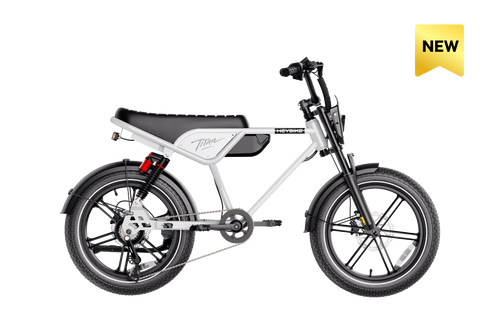
Titan Tested: 97/100 from RiderGuide